
In tropical countries, clay soils used in construction have unfavorable geotechnical properties and degrade prematurely due to their low bearing capacity and sensitivity to water, such as those of Bingerville, in southern Cote d'Ivoire, where these soils are the raw material for infrastructures projects. The use of improvement techniques such as treatment with hydraulic binders can improve the geotechnical properties of these soils by increasing their physical and mechanical strength in many countries where these materials are abundant, thereby reducing material transportation costs and environmental pollution. This study characterizes the clay soils of Bingerville in their natural state for their identification and suitability for treatment before subjecting them to lime and cement mixtures. The results of this study showed that the clay soils of Bingerville are clayey sands. After analysis, they are suitable for mixed treatment (lime-cement) in order to increase their geotechnical properties for their use in road techniques. Laboratory tests identified an optimal mixture of 3% lime and 6% cement. The experimental results made it possible to obtain, on clayey soils in the initial state, the total organic matter content (TOC), equal to 0.15%, a very low value, less than 1%, showing that these soils can support any load without deforming under the influence of water, therefore suitable for binder treatments. The plasticity index (PI) equal to 23.7%, a value greater than 12%, suggests that these clayey soils are subject to mixed Batard treatment (lime-cement). After treatment of Bingerville clay soils with lime and cement mixtures, dry densities increased from 1.83 to 2.03, with the 95% California Bearing Ratio (CBR) of the Modified Optimum Proctor (MOP) at 4 days of immersion increasing significantly from 14 to 94. These results are consistent with the recommendations for their use as treated local soils in low to medium traffic road projects.
| Published in | International Journal of Materials Science and Applications (Volume 14, Issue 6) |
| DOI | 10.11648/j.ijmsa.20251406.11 |
| Page(s) | 252-262 |
| Creative Commons |
This is an Open Access article, distributed under the terms of the Creative Commons Attribution 4.0 International License (http://creativecommons.org/licenses/by/4.0/), which permits unrestricted use, distribution and reproduction in any medium or format, provided the original work is properly cited. |
| Copyright |
Copyright © The Author(s), 2025. Published by Science Publishing Group |
Clayey Sands, Soil Treatment, Bingerville, Lime, Cement, Batard
Longitude | Latitude |
|---|---|
3°53’42’’32 W * | 5°21’32’’38 N |
Proportion of Soil Types | Terminology | Examples |
|---|---|---|
>35% | gives the name of the soil | Gravel, sand, silt, etc |
20% to 35% | gives the adjective | Gravelly, sandy, etc |
10% to 20% | A little | With traces of clay, silt, etc |
<10% | defines the trace |
TOM (% weight) | Classe | Soil suitability |
|---|---|---|
< 0.5 | Poor | Fit |
0.5-1 | Average | Fit |
1-2 | Good | Fit |
2-4 | Very good | Unfit |
> 4 | Excellent | Unfit |
Treatment Type | Suitability for Treatment | Volumetric Swelling Cg (%) |
|---|---|---|
Treatment with LHR or Cement | Directly Suitable | Cg ≤ 5 |
"Accelerated" Test | Doubtful: Potentially | 5 ˂ Cg ≤ 10 |
7 days - 40°C | Unsuitable: Insufficient | Cg > 10 |
Fractions | Soils | Particle composition of grains (%) by diameter |
|---|---|---|
Coarse | Gravel (2mm < Φ < 20mm) | 6 |
Sand (80µm < Φ < 2mm) | 44 | |
Fine | Silt ((2µm < Φ < 80 µm) | 26 |
Clay (< 2 µm) | 24 |
Dry density (g/cm3) | Optimal water content (%) | |
|---|---|---|
Clayey sands | 1.83 | 16.58 |
CBR at 95% | Equivalent layer | Road type | |
|---|---|---|---|
Clayey sands | 14 | Platform | Not defined |
Parameters | Percentages (%) |
|---|---|
Liquid Limit (WL) | 60.6 |
Plastic Limit (WP) | 36.9 |
Plasticity Index (PI) | 23.7 |
No. Dosage | 1 | 2 | 3 | 4 | 5 | 6 | 7 | 8 | 9 |
|---|---|---|---|---|---|---|---|---|---|
% Lime | 1 | 1 | 1 | 2 | 2 | 2 | 3 | 3 | 3 |
% Cement | 2 | 4 | 6 | 2 | 4 | 6 | 3 | 3 | 3 |
Optimal Water Content (%) | 15.2 | 17.6 | 18.0 | 16.2 | 14.8 | 14.4 | 14.4 | 14.4 | 14.3 |
Dry density (g/cm3) | 2.03 | 2 | 1.95 | 1.8 | 1.85 | 1.92 | 1.86 | 1.65 | 1.95 |
Range | 1 | 2 | 3 |
No. Dosage | 1 | 6 | 9 |
|---|---|---|---|
Lime% | 1 | 2 | 3 |
Cement% | 2 | 2 | 6 |
CBR at 95% of the MOP | 35 | 50 | 64 |
CBR | California Bearing Ratio |
LBTP | Laboratoire du Bâtiment et des Travaux Publiques (Building and Public Works Laboratory in Cote d’Ivoire) |
MOP | Modified Optimum Proctor |
C-S-H | Calcium Silicate Hydrate |
ALIZE-LCPC | Software for Pavement Structure Design |
| [1] | Helson, O., Eslami, J., Beaucour, A.-L., Noumowe, A., & Gotteland, P. (2014). Influence of soil clay content on the physico-mechanical properties of soil concrete. 32nd AUGC Meet. |
| [2] | Kouakou, C. H. (2005). Valorisation Valorization of clays from Ivory Coast: Study of the cold stabilization of Dabou clay with a hydraulic binder (Portland cement), Doctoral Thesis. University of Cocody Abidjan, 184 p. |
| [3] | XP P94-202. (1995). Soils: investigation and testing - Soil and rock sampling - Methodology and procedures. Afnor Editions, Earthworks. Excavation. Foundations. Underground works, 42 p. |
| [4] |
LBTP. (2021). Implementation report of the second phase of the UEMOA Regional Economic Programme (PER II) in Côte d'Ivoire at the end of December 2021, Report. CNS PER/PCD. 38 p.
https://www.dge.gouv.ci/sites/default/files/dgeDoc/RAPPORT%20PER%20A%20FIN%20DEC%202021%20VF.pdf |
| [5] | EN 459-1 (2015). Construction lime – Part 1: definition, specification and conformity criteria. Paris, France: Afnor Editions. 12 p. |
| [6] | CIM-BETON. (2008). Design and dimensioning, roads and urban development in concrete. Technical Collection. T50, 125 p. |
| [7] | NF P94-056. (1996). Soils: identification and testing - Particle size analysis - Dry sieving method after washing. Afnor Editions, 15 p. |
| [8] |
Guettouche, A. (2016). Soil Mechanics I. Course, Department of Civil Engineering, Ferhat Abbas-Setif 1 University, Algeria, 51 p.
https://fr.scribd.com/document/390797744/Cours-Guettouche-Amar |
| [9] |
CEBTP. (1984). Practical guide to road design in tropical countries 2, 157 p.
https://www.francescomiceli.com/blog/Guide_pratique_dimensionnement.pdf |
| [10] |
Peters, K. E., & Cassa, M. R. (1994). Applied Source Rock Geochemistry-The Petroleum System from Source to Trap. In: Magoon, L. B., Dow, W. G., Eds., The Petroleum System from Source to Trap, American Association of Petroleum Geologists, Memoir 60, Chapter 5, 93-120.
https://www.researchgate.net/publication/267838577_I_Applied_Source_Rock_Geochemistry |
| [11] | NF EN 13286-49. (2004). Treated and untreated mixtures with hydraulic binders - Part 49: Accelerated swelling test for soil treated with lime and/or a hydraulic binder. Afnor Editions, National Standards and National Normative Documents, 15 p. |
| [12] | LCPC. (2007). Technical Guide - Soil treatment with lime and/or hydraulic binders - Technical guide, SETRA-LCPC, France. Cerema Editions, 66 p. |
| [13] | NF P94-051. (1993). Soils: investigation and testing - Determination of Atterberg limits - Liquid limit by cup test - Plastic limit by roller test. Afnor Editions, 15 p. |
| [14] | Lavallee, E., & Bance, Y. (2018). Valorization of local materials improved with cement (sandy and lateritic gravelly soils) in the base of semi-rigid pavements. African Geotechnical Days. 10th edition, Abidjan, 6-28. |
| [15] | GTS. (2015). Technical guide for the use of alternative materials from Franche-Comté in road construction. Clister Eco-chantiers, 49 p. |
| [16] | Abdo, J. (2008). In-situ soil treatment with hydraulic binders, Day for the Valorization of mediocre soils, Paris, 1-52. |
| [17] | NF P94-102-2. (2001). Methodology for laboratory formulation studies of soils treated with a hydraulic binder (possibly with lime) intended for use in sub-base layers. Afnor Editions, 11 p. |
| [18] | Grehoa, A. M. (2016). Laterite in road base construction: analysis of the performance of lateritic soils from some localities in Côte d'Ivoire (Anyama, Divo and Korhogo). Master's thesis, Felix Houphouët Boigny University, Abidjan, 62 p. |
| [19] | Autret, P. (1983). Laterites and lateritic gravels. ISTED-LCPC studies, France, 38 p. |
| [20] |
National Research Council (U.S.). (1976). Lime stabilization: reactions, properties, design, and construction. State of the Art, Report. N 5, Transportation Research Board, National Research Council, Washington, DC., 59 p.
https://onlinepubs.trb.org/Onlinepubs/trcircular/180/180.pdf |
| [21] | G. (1996). Lime stabilization of clay minerals and soils. Engineering Geology, Vol. 42, Issue 4, 223-237. |
| [22] | Basha, E. A., Hashim, R., Mahmud, H. B., & Muntohar A. S. (2005). Stabilization of residual soil with rice husk ash and cement. Construction and building Materials. 19(6), 448-453. |
APA Style
Pierre, K. K., Seraphin, D. A., Athanas, K., Gbele, O. (2025). Influence of the Treatment of Bingerville Clayey Sands with a Batard Binder Mixture (Lime-cement) for Use in Road Engineering. International Journal of Materials Science and Applications, 14(6), 252-262. https://doi.org/10.11648/j.ijmsa.20251406.11
ACS Style
Pierre, K. K.; Seraphin, D. A.; Athanas, K.; Gbele, O. Influence of the Treatment of Bingerville Clayey Sands with a Batard Binder Mixture (Lime-cement) for Use in Road Engineering. Int. J. Mater. Sci. Appl. 2025, 14(6), 252-262. doi: 10.11648/j.ijmsa.20251406.11
AMA Style
Pierre KK, Seraphin DA, Athanas K, Gbele O. Influence of the Treatment of Bingerville Clayey Sands with a Batard Binder Mixture (Lime-cement) for Use in Road Engineering. Int J Mater Sci Appl. 2025;14(6):252-262. doi: 10.11648/j.ijmsa.20251406.11
@article{10.11648/j.ijmsa.20251406.11,
  author = {Kouassi Kouakou Pierre and Djomo Agre Seraphin and Konin Athanas and Ouattara Gbele},
  title = {Influence of the Treatment of Bingerville Clayey Sands with a Batard Binder Mixture (Lime-cement) for Use in Road Engineering},
  journal = {International Journal of Materials Science and Applications},
  volume = {14},
  number = {6},
  pages = {252-262},
  doi = {10.11648/j.ijmsa.20251406.11},
  url = {https://doi.org/10.11648/j.ijmsa.20251406.11},
  eprint = {https://article.sciencepublishinggroup.com/pdf/10.11648.j.ijmsa.20251406.11},
  abstract = {In tropical countries, clay soils used in construction have unfavorable geotechnical properties and degrade prematurely due to their low bearing capacity and sensitivity to water, such as those of Bingerville, in southern Cote d'Ivoire, where these soils are the raw material for infrastructures projects. The use of improvement techniques such as treatment with hydraulic binders can improve the geotechnical properties of these soils by increasing their physical and mechanical strength in many countries where these materials are abundant, thereby reducing material transportation costs and environmental pollution. This study characterizes the clay soils of Bingerville in their natural state for their identification and suitability for treatment before subjecting them to lime and cement mixtures. The results of this study showed that the clay soils of Bingerville are clayey sands. After analysis, they are suitable for mixed treatment (lime-cement) in order to increase their geotechnical properties for their use in road techniques. Laboratory tests identified an optimal mixture of 3% lime and 6% cement. The experimental results made it possible to obtain, on clayey soils in the initial state, the total organic matter content (TOC), equal to 0.15%, a very low value, less than 1%, showing that these soils can support any load without deforming under the influence of water, therefore suitable for binder treatments. The plasticity index (PI) equal to 23.7%, a value greater than 12%, suggests that these clayey soils are subject to mixed Batard treatment (lime-cement). After treatment of Bingerville clay soils with lime and cement mixtures, dry densities increased from 1.83 to 2.03, with the 95% California Bearing Ratio (CBR) of the Modified Optimum Proctor (MOP) at 4 days of immersion increasing significantly from 14 to 94. These results are consistent with the recommendations for their use as treated local soils in low to medium traffic road projects.},
 year = {2025}
}
TY  - JOUR
T1  - Influence of the Treatment of Bingerville Clayey Sands with a Batard Binder Mixture (Lime-cement) for Use in Road Engineering
AU  - Kouassi Kouakou Pierre
AU  - Djomo Agre Seraphin
AU  - Konin Athanas
AU  - Ouattara Gbele
Y1  - 2025/12/09
PY  - 2025
N1  - https://doi.org/10.11648/j.ijmsa.20251406.11
DO  - 10.11648/j.ijmsa.20251406.11
T2  - International Journal of Materials Science and Applications
JF  - International Journal of Materials Science and Applications
JO  - International Journal of Materials Science and Applications
SP  - 252
EP  - 262
PB  - Science Publishing Group
SN  - 2327-2643
UR  - https://doi.org/10.11648/j.ijmsa.20251406.11
AB  - In tropical countries, clay soils used in construction have unfavorable geotechnical properties and degrade prematurely due to their low bearing capacity and sensitivity to water, such as those of Bingerville, in southern Cote d'Ivoire, where these soils are the raw material for infrastructures projects. The use of improvement techniques such as treatment with hydraulic binders can improve the geotechnical properties of these soils by increasing their physical and mechanical strength in many countries where these materials are abundant, thereby reducing material transportation costs and environmental pollution. This study characterizes the clay soils of Bingerville in their natural state for their identification and suitability for treatment before subjecting them to lime and cement mixtures. The results of this study showed that the clay soils of Bingerville are clayey sands. After analysis, they are suitable for mixed treatment (lime-cement) in order to increase their geotechnical properties for their use in road techniques. Laboratory tests identified an optimal mixture of 3% lime and 6% cement. The experimental results made it possible to obtain, on clayey soils in the initial state, the total organic matter content (TOC), equal to 0.15%, a very low value, less than 1%, showing that these soils can support any load without deforming under the influence of water, therefore suitable for binder treatments. The plasticity index (PI) equal to 23.7%, a value greater than 12%, suggests that these clayey soils are subject to mixed Batard treatment (lime-cement). After treatment of Bingerville clay soils with lime and cement mixtures, dry densities increased from 1.83 to 2.03, with the 95% California Bearing Ratio (CBR) of the Modified Optimum Proctor (MOP) at 4 days of immersion increasing significantly from 14 to 94. These results are consistent with the recommendations for their use as treated local soils in low to medium traffic road projects.
VL  - 14
IS  - 6
ER  -
Laboratory of Geographic Sciences, Civil Engineering and Geosciences (LASCIG3), Felix Houphouet-Boigny National Polytechnic Institute, Yamoussoukro, Cote d’Ivoire
Department of Earth Sciences, Jean Lorougnon Guede University, Daloa, Cote d’Ivoire
Laboratory of Geographic Sciences, Civil Engineering and Geosciences (LASCIG3), Felix Houphouet-Boigny National Polytechnic Institute, Yamoussoukro, Cote d’Ivoire
Laboratory of Geographic Sciences, Civil Engineering and Geosciences (LASCIG3), Felix Houphouet-Boigny National Polytechnic Institute, Yamoussoukro, Cote d’Ivoire
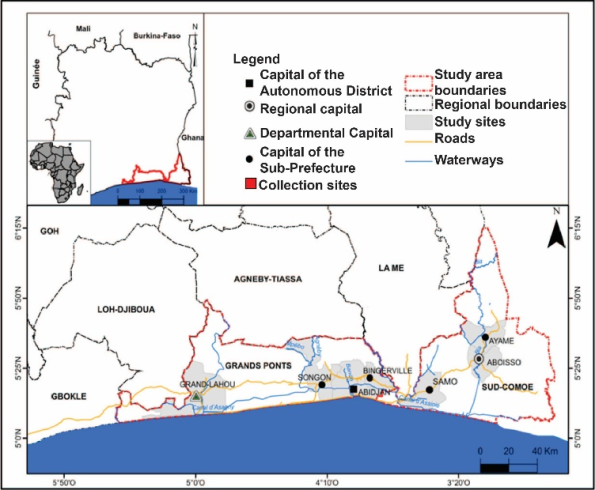
Figure 1. Location of the sampling sites for the reworked clay soils in the study.
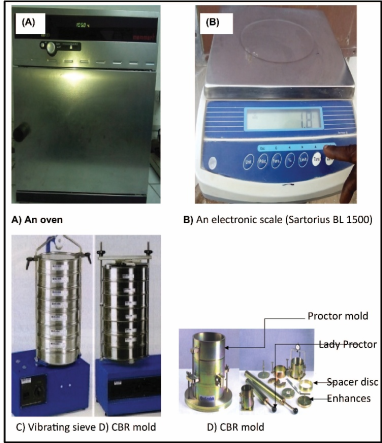
Figure 2. Laboratory Equipment.
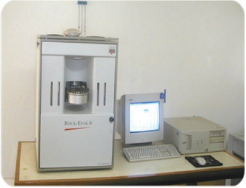
Figure 3. Rock Eval Device.
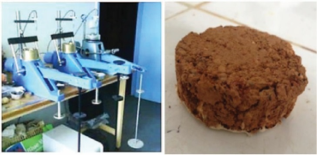
Figure 4. Oedometric device and soil specimen after compressibility testing.
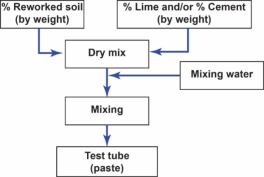
Figure 5. Steps in formulating compaction specimens [18].
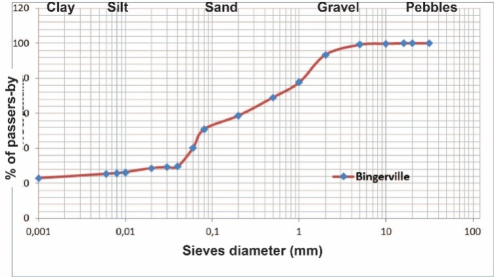
Figure 6. Grain size distribution curve of Bingerville clay soils.
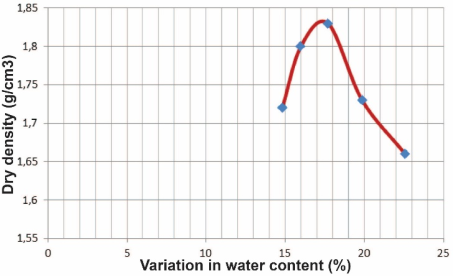
Figure 7. Modified Proctor Curve of Bingerville clay soils.
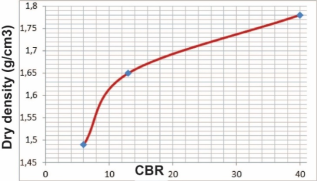
Figure 8. CBR curves of Bingerville clayey sands in their natural state.
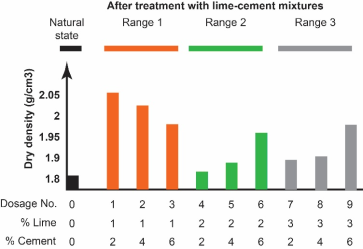
Figure 9. Change in dry density as a function of lime-cement mixtures of Bingerville clayey sands.
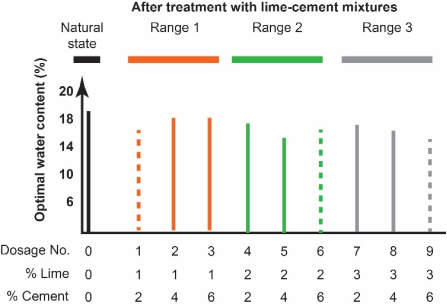
Figure 10. Change in optimal water content as a function of lime-cement mixtures of Bingerville clayey sands.
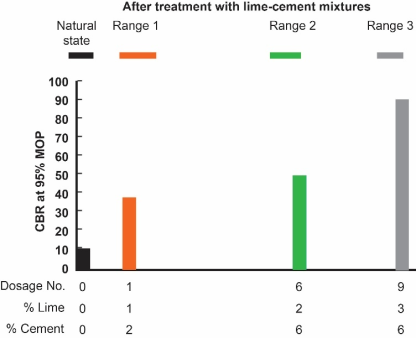
Figure 11. Influence of the lime-cement mixture on the CBR at 95% of the MOP of Bingerville clayey sands.




 Share This Article
 Twitter
 Linked In
 Facebook
 Copy
Copy Download